
Do you think about time a lot? How little of it you have? How quickly it’s passing? Or maybe how interminably it’s dragging on? How it seems to change with the rhythms of life? How the days are long but the years are short? And how a year is so much shorter than it used to be?
We humans are necessarily consumed by time. We experience most of life through the lens of time. We live life on a clock. Time’s fleeting nature spoils even the best of times with the knowledge that they won’t last, while the assurance that “this too shall pass” simultaneously carries us through the worst of times.
Yet we live in a world that tries to shield itself from the essential nature of time. Society preaches that we can stay young forever. We bury our heads in the sand like ostriches when any stray reminder of death finds its way past our blinders. We cover up wrinkles, rather than embracing a face lined with wisdom and care and laughter. We pluck gray hairs, instead of graciously accepting them as a crown of glory gained in a righteous life. Have you ever noticed that we don’t build graveyards next to churches anymore?
I don’t think we need Scripture to figure out that this is a horrendous idea. Christians didn’t come up with memento mori. Death is the only certain thing in life, and time is the unstoppable force sweeping us towards it much faster than most of us would like. I’m dying. You’re dying. If you pretend you aren’t, you’ll still end up in the dirt just like me — except you’ll clumsily stumble into that grave blind and full of regrets. Nevertheless, Scripture does make it extremely clear that we ought to meditate on our death. Dust you are, and to dust you shall return. Naked you came from your mother’s womb, and naked you shall return.
“So teach us to number our days that we may get a heart of wisdom” (Psalm 90:12).
All this reflection on time and death stings, and for good reason. Our Maker didn’t fashion us for death. He made us in the image and likeness of eternity. “He has put eternity into man's heart” (Ecclesiastes 3:11). We live life on a perpetual bad diet. God made us to feast from the Tree of Life, but we’re stuck eating junk food that cannot sustain us. So we age and decay. We break down and die. We live life at the mercy and whim of time.
We all know that death has lost its sting. For the Christian, the Resurrection turns time into a swift river carrying us home. We still must die, since death is the last enemy to be destroyed, but we serve a King who showed us the way out of the grave.
But have you considered how time itself will lose its sting? Time doesn’t just sting because of its friendship with death. The eternity in our hearts strains under the burden of time itself. God doesn’t experience time, and we weren’t really meant to either. A thousand years is as a day to him, and a day is as a thousand years. And he invites us into that same relationship to time.
Common grace already grants us glimpses of this reality. Think about those moments where time doesn’t seem to exist. It doesn’t speed up or slow down — it vanishes. For me, it happens on rare occasions when I go for a run. The world around me melts away. I exult in the eternal now, to borrow a phrase from C.S. Lewis. My heart pounds and blood courses through my veins. I’m alive. I’m not thinking about what came before or what’s coming after. I just am. Time doesn’t merely fly when I’m having fun (or running). It flees from me. I cease to be under its thumb.
Something similar happens when I’m reading an exceptionally good book. It can also happen in the midst of lively conversation at a dinner table among family or friends, as well as on Sunday mornings. But these moments are always short-lived. I inevitably finish my run and have to submit to the excruciating process of bowing to the tyranny of time once again. I imagine astronauts go through something similar when they learn to live with gravity again (which would, of course, make perfect sense with Einstein’s theory of relativity).
As an aside, it’s worth noting that this experience has a counterfeit shadow. It’s possible to escape the tyranny of time by submitting to an even worse master. Heaven and hell alike have the power to grant an existence that doesn’t end. Heaven offers eternal life, and hell offers eternal death. Both free you from the oppression of time, but you should choose wisely, lest you jump out of the frying pan and into the fire.
The lotus flowers in the Odyssey aptly capture the hell of eternal death. They trap Odysseus and his crew in a perpetual, sluggish present. They’re technically freed from the sting of time, but only by losing everything else that matters — their longing for home, their sense of duty, their hopes and dreams. They don’t grieve the passage of time, but only because they’ve already been robbed of all the precious things time was stealing from them. They get a life-sucking eternal present, rather than a life-giving eternal present.
If you’ve ever doom-scrolled, you’ve experienced something very similar. You can lose 10 minutes in the blink of an eye. But that’s just it — you lost those minutes. Were you living in those 10 minutes, or were you dying? That’s the litmus test. When you return to the land of time, do you feel as though you climbed back up from the pit of hell, or is your face radiating from the presence of God like Moses after descending from the mountain?
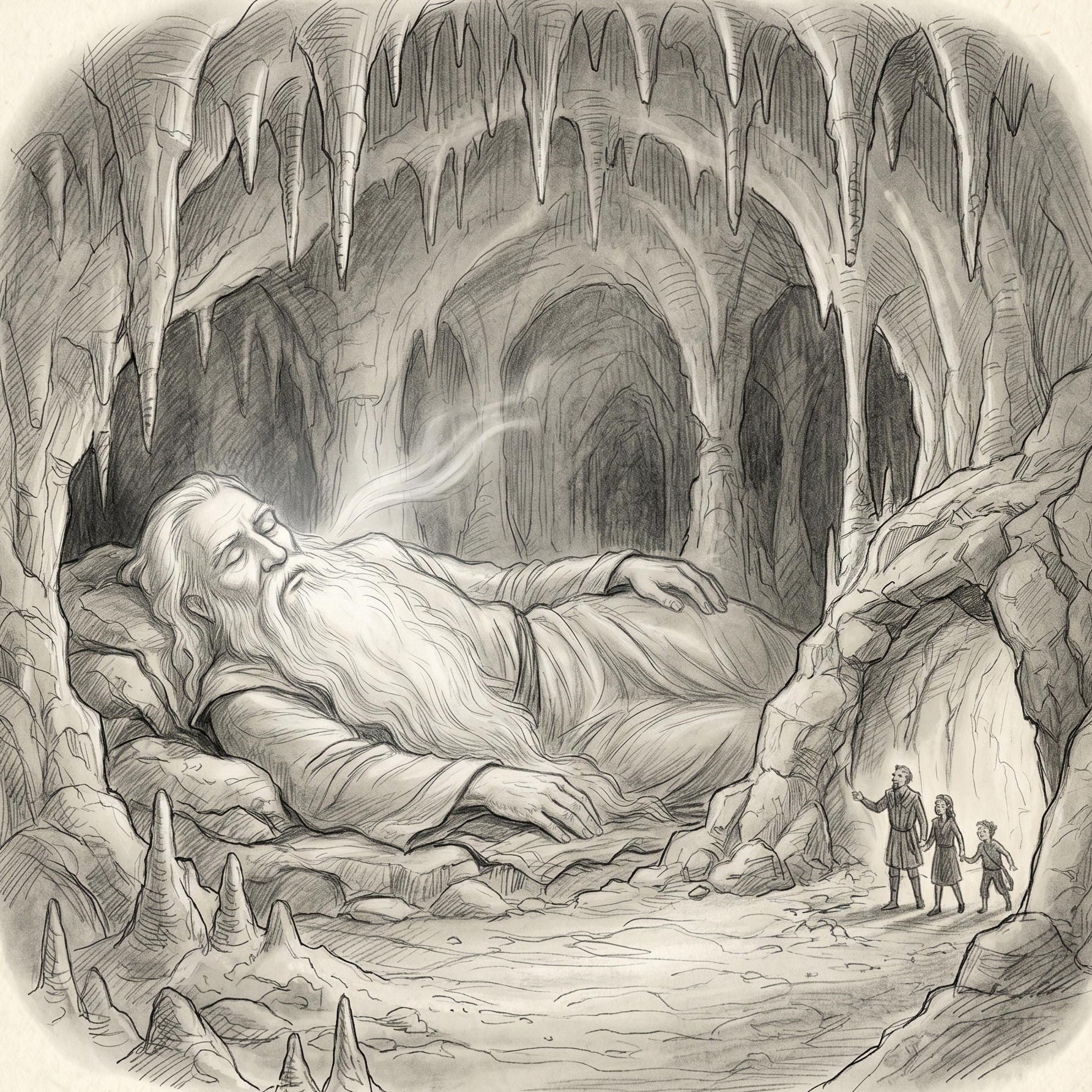
To close, I’ll switch up the metaphor. Maybe time isn’t a tyrant. Maybe he’s a sleeping giant. That’s how C.S. Lewis depicts Father Time in The Silver Chair — as a “noble and beautiful” giant, far larger than any of the evil giants. But he’s asleep.
“That is old Father Time, who once was a King in Overland," said the Warden. "And now he has sunk down into the Deep Realm and lies dreaming of all the things that are done in the upper world. Many sink down, and few return to the sunlit lands. They say he will wake at the end of the world.”
For C.S. Lewis, the problem isn’t that we’re under the tyranny of Father Time. He’s actually a benevolent King, but his throne has been empty since the world began. The time we experience is a sleeping, dreaming time. It’s real, but it’s not the truest reality. When Father Time wakes up at the end of the world, then we’ll know time as it really is.
Sure enough, in The Last Battle, when Aslan wakes Father Time, he tells Jill and Eustace that he shall receive a new name. We never learn the new name, but the implication is clear. Linear, chronological time itself was only a temporary condition. In Aslan’s country, time is known by a different name and serves a different purpose. If I had to venture a guess, I’d say his new name is probably Eternity.
“While he lay dreaming his name was Time. Now that he is awake he will have a new one.”
At Aslan’s behest, the one who was formerly known as Father Time blows a horn and unmakes the world, turning everything into black emptiness — the end of Narnia. But of course for our characters, that’s only the beginning. They step through the door to Aslan’s country and find that Father Eternity is awake and reigning. And eternity works backwards. It swallows up everything that came before it, turning every agonizing sting into pure bliss. That’s how time loses its sting — by waking up.
“Son,” he said, “ye cannot in your present state understand eternity... but ye can get some likeness of it if ye say that both good and evil, when they are full grown, become retrospective. Not only this valley but all this earthly past will have been Heaven to those who are saved... They say of some temporal suffering, ‘No future bliss can make up for it,’ not knowing that Heaven, once attained, will work backwards and turn even that agony into a glory. [...] And that is why, at the end of all things, when the sun rises here and the twilight turns to blackness down there, the Blessed will say, ‘We have never lived anywhere except in Heaven,’ and the Lost, ‘We were always in Hell’” (C.S. Lewis, The Great Divorce).
The clock is still ticking for us today. We are still dying. But if we number our days with this reality in mind, we don't have to dread the unstoppable force of time. We can let the sand drain from the glass, knowing that when Time finally wakes up, he’ll receive a new name. He will be the one working backwards to turn these long days and short years into an eternal glory.