
Theology is a dangerous game. Of course, knowing God is the highest pursuit. In fact, it’s the only thing worth boasting about:
“But let him who boasts boast in this, that he understands and knows me” (Jeremiah 9:24).
But if you think organic chemistry and thermodynamics and quantum physics are complex and difficult subjects, what do you think it’s like to study the God who designed quarks and leptons? Care to fully explain the Trinity for me real quick? Or how about the hypostatic union? And because theology is the subject that frames all other subjects, theological errors cascade and infiltrate every other subject. If you don’t properly know the God who spoke the world into existence, your study of that world is bound to be pretty much dead on arrival.
When you really think about it, the idea that we could ever hope to know anything meaningful about God seems laughably absurd. Imagine a colony of ants trying to understand and know us humans. It’s a futile endeavor. We have several orders of magnitude more neurons in our brains than they do. I doubt an ant brain is even physically capable of understanding anything significant about humans. They simply don’t have the hardware for it.
Next to God, we’re the ants. Only the divide is infinitely larger. Ants are our close neighbors by comparison. Based on a quick Google search, ants share 33% of our DNA (we also share 44% of our DNA with bananas, just in case you happened to be wondering). We’re on the same side of the Creator/creature distinction as ants. But God is on the other side of that gigantic chasm. Much like ants, we really don’t have the hardware to properly conceive of God. What are our 86 billion neurons next to the 200 sextillion stars in the observable universe — all of which God spoke into existence in one moment with a single sentence?
“And God said, 'Let there be light,' and there was light” (Genesis 1:3).
We are fallen, finite, temporal creatures wrestling with a perfect, transcendent, infinite, eternal God. Surely man is just a breath! His thoughts are not our thoughts, nor are his ways our ways.
“For my thoughts are not your thoughts, neither are your ways my ways, declares the Lord. For as the heavens are higher than the earth, so are my ways higher than your ways and my thoughts than your thoughts” (Isaiah 55:8-9).
Does it feel hopeless yet? It probably should. We don’t want to make the mistake Job makes. Though he was blameless and upright before God, his effort to understand God yielded little fruit. Even after an extended personal audience with God — and after 42 chapters of struggling — the best he can do is shut his mouth and keep quiet:
“Behold, I am of small account; what shall I answer you? I lay my hand on my mouth” (Job 40:4).
"Therefore I have uttered what I did not understand, things too wonderful for me, which I did not know” (Job 42:3).
Likewise with Paul. He was a divinely inspired apostle who authored 75% of the New Testament. He literally met Jesus on the road to Damascus. He wrote some of the best theological treatises known to man. But guess what he has to say?
“Oh, the depth of the riches and wisdom and knowledge of God! How unsearchable are his judgments and how inscrutable his ways! For who has known the mind of the Lord, or who has been his counselor? Or who has given a gift to him that he might be repaid?” (Romans 11:33-35).
When you look at it this way, it seems like a waste of time, doesn’t it? But Scripture promises that we can know God:
“You will seek me and find me, when you seek me with all your heart” (Jeremiah 29:13).
"This is eternal life, that they know you, the only true God, and Jesus Christ whom you have sent” (John 17:3).
Were we on our own, it really would be a waste of time. We might be able glean just enough from the created order to incriminate ourselves (Romans 1:20), but probably not much more than that. But God made us in His image and likeness with the capacity to reason and think. And then he went a step further and gave us the Bible. And then he went a giant leap further by taking on flesh and dwelling among us.
“Whoever has seen me has seen the Father” (John 14:9).
So we do at least have some hope of knowing God. But while God’s revelation makes it possible to know God, it hardly removes the difficulty. The giant Creator/creature chasm still yawns before us. God’s Word, both in the flesh and on the pages of Scripture, forms a bridge across the canyon, but it’s one of those precarious, narrow rope bridges that sways and creaks under your weight.
There are all sorts of reasons the bridge is precarious. We don’t have the original autographs. Most of us read translations of Scripture, not the original languages. We’re fallen, sinful, biased readers. The list probably goes on. But I’m most interested in the limitations of human language.
Language has severe limitations. The things of God run deeper than words. We’ve all felt this limitation. We’ve all struggled to find the right words at times. Paul says as much in Romans:
“For we do not know what to pray for as we ought, but the Spirit himself intercedes for us with groanings too deep for words” (Romans 8:26).
Augustine shares a similar sentiment in his Confessions:
“You are my God, my Life, my holy Delight, but is this enough to say of you? Can any man say enough when he speaks of you? Yet woe betide those who are silent about you! For even those who are most gifted with speech cannot find words to describe you” (Augustine).
Even beyond this difficulty, language puts limits on God. It works by categorizing things. Words define what a thing is and what a thing isn’t. So when you try to put something to words, you’re putting that thing in a box. And that’s a pretty dangerous thing to do with God. That’s why my freshman theology professor defined heresy as trying to say too much about God.
“We often try to put God in a box. The God who fits in our boxes isn’t the God and Father of our Lord Jesus Christ” (A.W. Tozer).
God has a solution for us, but it’s not necessarily a pleasant one. Simple words, categories, and boxes cannot contain God. Nor can simple words and truths convey an accurate picture of God. Just look at how God describes himself to Moses: “I AM WHO I AM.” A straightforward, easily understood name or description would be inadequate. Instead, God relies on a seemingly circular statement to communicate his self-existence.
In addition to statements like these, God often presents us with various truths that seem to pull us in opposite directions. Often, they are paradoxical. Sometimes they even seem like contradictions. God forces us to live in constant tension, stuck with disparate truths that shatter our pre-existing categories and force us to accept that God is too complex for our brains to ever fully understand.
“God intends to explode our pitiful little categories by insisting in the strongest terms that we be pulled in opposite directions. These are not contradictions. There may be paradox, and there is certainly tremendous mystery, but if we are going to submit our patterns and categories of thinking to the Bible, then we must allow them to be stretched and pulled (and sometimes put to death altogether) in order to remain faithful to what God has said” (Joe Rigney, The Things of Earth).
There are countless examples of this. For example, God is sovereign over our actions, yet we’re responsible for those actions. God is one, yet God is also three. Jesus is a Lion and a Lamb. Jesus is fully man and fully God. We are sinners, and we are saints. The first shall last, and the last shall be first. You have to lose your life to find it. God is transcendent, but also immanent. God is merciful and just — a God of love and thunder. We are saved by faith alone, but faith without works is dead. We are supposed to love our enemies, but we are also called to hate those who hate God (Psalm 139:19-22). The list goes on.
Augustine has his own list in Confessions:
“You are the most hidden from us and yet the most present amongst us, the most beautiful and yet the most strong, ever enduring and yet we cannot comprehend you. You are unchangeable and yet you change all things. You are never new, never old, and yet all things have new life from you. You are the unseen power that brings decline upon the proud. You are ever active, yet always at rest. You gather all things to yourself, though you suffer no need… You grieve for wrong, but you suffer no pain. You can be angry and yet serene. Your works are varied, but your purpose is one and the same. You welcome all who come to you, though you never lost them” (Augustine).
These paradoxes and category-defying truths hurt our brains. What do we expect to happen when we try to cram attributes of an infinite God into our finite skulls? Biblical truths pull us in opposite directions, force us to live in the discomfort of that tension, and stretch us almost to our breaking point. It’s sort of like trying to look at the sun. We can’t behold the sun in its full radiance without burning our retinas. So it is with the God who spoke that sun into existence and commands it to rise each morning (Job 38:12).
“…who alone has immortality, who dwells in unapproachable light, whom no one has ever seen or can see” (1 Timothy 6:16).
This is God’s solution. Far from an easy solution, it’s actually quite painful. Our minds ache as they try to grasp the eternal reality with which we reckon. Are you willing for God to offend your mind if it means you can know him more fully?
The temptation is often to overemphasize one truth over another — to compromise one truth in favor of another. It’s not hard to see people doing just that in every age, including today. For instance, many today neglect God’s wrath in favor of his love, with disastrous consequences. Because they know nothing of God’s wrath, they develop a skewed and perverted understanding of his love. Worse still, they miss out entirely on the coherent resolution of the two opposing truths, which is worth far more than just the sum of its parts.
We simply must embrace the tension if we want to have any hope of knowing God rightly. The discomfort itself plays a role in acquainting us with God. So says Augustine:
“People who seek God, and stretch their minds as far as human weakness is able toward an understanding of the trinity, must surely experience the strain of trying to fix their gaze on light inaccessible (1 Tim. 6:16), and the difficulties presented by the holy scriptures in their multifarious diversity of form, which are designed, so it seems to me, to wear Adam down and let Christ's glorious grace shine through” (Augustine, The Trinity).
Augustine was convinced that God wove all these competing truths into Scripture intentionally, specifically to stretch our minds, in order to “wear Adam down and let Christ’s glorious grace shine through.” So we would be foolish to resist the mystery, lest we suppress Christ’s glorious grace. Instead, we ought to lean into the tension, wrestle with it, and submit to the painful renewing of our minds, so that the patterns and categories of our thinking might be faithful to the God whom the Scriptures reveal. For only when our minds are renewed can we “discern what is the will of God, what is good and acceptable and perfect” (Romans 12:2).
“So if you can’t seem to reconcile two truths that are clearly taught in the Bible, resist the impulse to compromise one or the other. Refuse to allow one truth to mute another truth. Labor to hold them in tension. Be willing to be stretched. Don’t hold one biblical truth so closely that you refuse to let all of Scripture speak. Don’t despair when your mind aches because of the tension. You should expect paradox, you should expect mystery, you should expect to have your categories blown, and your mind stretched, and your heart expanded so that you can take in more and more of God” (Joe Rigney, The Things of Earth).
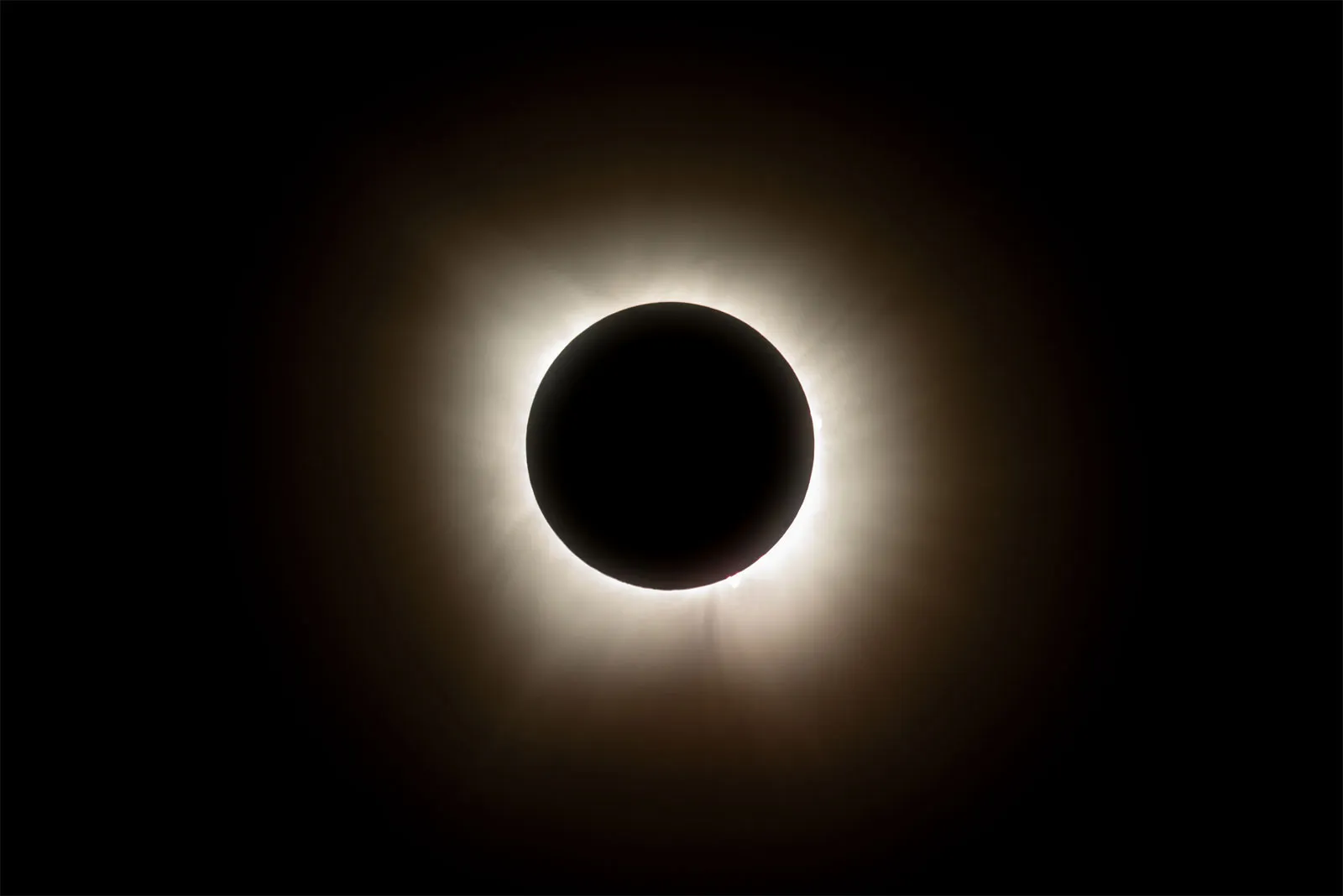
Fortunately, we will not be stuck in this tension forever. We will live to see its glorious resolution. Yes, God is too bright for us right now. Much like we need glasses to look at the sun, even when it is already darkened by the moon during an eclipse, so now we can only see God through a glass darkly. But one day, we will see him face to face. One day, we will know God fully — as fully as he knows us.
“For now we see through a glass, darkly; but then face to face: now I know in part; but then shall I know even as also I am known” (1 Corinthians 13:12).
Are you ready for the reckoning?
How long until this curtain is lifted?
How long is this the song that we sing?
How long until the reckoning?
…
You are holiness and grace.
You are fury and rest.
You are anger and love.
You curse and you bless.
You are mighty and weak.
You are silence and song.
You are plain as the day,
But you have hidden your face.
For how long? How long?
...
And I know that I don't know what I'm asking,
But I long to look you full in the face.
I am ready for the reckoning
(Andrew Peterson, The Reckoning).